Skip to content
Development / mechanism map

How Scaling Laws actually works.

This is not the feature list. It is the machinery underneath it: how a model gets a score, why hardware becomes a bad asset, why research cannot be brute-forced with cash, how rivals react and which numbers are measurements versus game abstractions.

Campaign start1 January 2022
Simulation stepOne deterministic day
Model qualityScaling law, not a random rating
Future dataProjected values are labelled
01 / Model quality

A bigger model is not automatically a better use of compute.

Training quality comes from one parametric scaling law. Parameter count and training tokens both matter, and the same compute budget can be wasted by pushing either side too far.

Scaling Laws uses a Chinchilla-style parametric loss form as the single place where model quality is computed. The player chooses parameter scale and data scale, then the game converts that plan into training compute and a relative capability projection.

ScalingLaw / only quality functionrelative simulation
L(N, D) = E + A / Nα + B / Dβ
N is parameter count. D is training tokens. The capability score shown by the game is a relative game scale, not a benchmark score such as MMLU.

The compute-optimal region in the current model lands around twenty training tokens per parameter. Ten times the effective training compute is mapped to roughly ten capability points at every scale. That fixed treadmill is what lets the moving frontier remain legible to the player.

Why the fit is not copied blindly

The project uses a corrected/re-derived Chinchilla fit rather than silently treating every printed constant in the 2022 paper as unquestionable. A 2024 replication attempt found that the paper's third estimation procedure was inconsistent with the first two and re-derived a compatible fit.


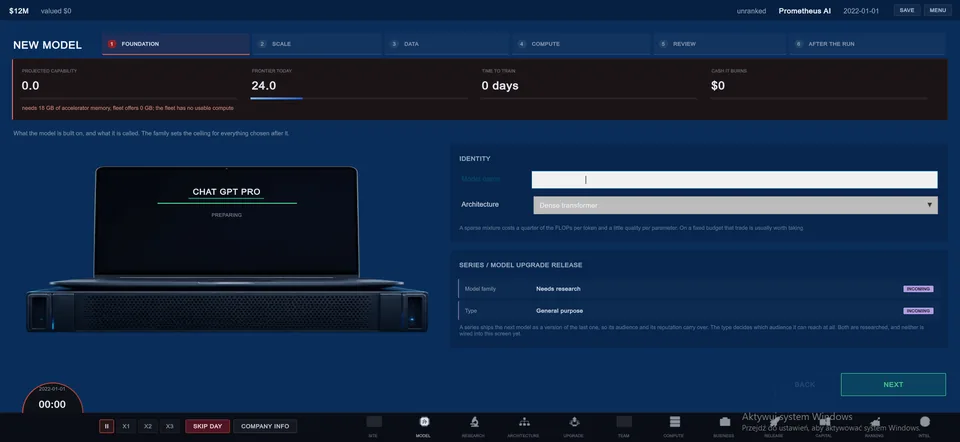
Scaling Laws staged model creator showing foundation, scale, data, compute and review stages
Current model creator. The projection reprices as the blueprint changes.
Real-world reference

What the research says

Hoffmann et al. trained more than 400 models and argued that compute-optimal model size and training tokens should scale together. Scaling Laws uses that relationship as a design reference, not as a claim that its 0–100 capability scale is a real benchmark.
Game abstraction

What the player gets

A single comprehensible number, a projected delta after each choice, a training time and a bill. The uncertainty only becomes a final capability after the run actually finishes.

02 / Hardware economics

Owned compute gets older while it is still working.

Hardware value falls in two separate ways: calendar age and successor generations. A launch that happens after you buy can hurt the resale value again.

The hardware catalog carries accelerator, host CPU, node memory and fabric data. Owned accelerators are not a permanent stat upgrade. They are dated assets. The valuation model applies time-based depreciation and a second penalty as newer generations of the same class arrive.

Time: value decays even if nothing new ships.
Successors: meaningful newer parts apply another phased hit.

This is why the hardware screen cannot become “pick the greenest card.” Waiting can preserve capital for a generation that improves performance per dollar. Waiting too long can also leave the company paying premium cloud rates while a rival trains on owned capacity.

Vendor specifications matter because accelerator performance is only part of the machine. NVIDIA's H100 SXM reference, for example, lists 80 GB of memory, 3.35 TB/s of memory bandwidth, up to 700 W TDP and 900 GB/s NVLink. Those dimensions are exactly why the game stores memory, power and interconnect data instead of reducing every part to one FLOPS number.

Catalog rule

Public specs when they exist

Hardware entries are based on public vendor specifications and release information, rounded for the simulation. A future or estimated entry is supposed to carry a projection flag rather than masquerade as measured data.

Player problem

The good purchase can be the wrong purchase

A powerful accelerator bought days before a better-value generation lands can be worse for the company than a slower cluster bought at the right point in the cycle.

03 / Compute

Renting removes one risk. Owning creates five more.


Cloud capacity arrives provisioned. Owned capacity has to be fed by host CPUs, node memory and fabric, then paid for whether the cluster is busy or not.

Rented cloudAvailable immediately. Contracted in petaflops rather than a unit count. Expensive, flexible and provisioned for the player.
Colocated serversA middle infrastructure tier with lead time and ownership. The company buys hardware without yet operating a full datacenter.
Own datacenterLate infrastructure with a much longer lead time, large capital gates and idle-capacity risk.

Support hardware is not decorative. The compute pool measures whether CPUs, memory and fabric can actually feed the owned accelerator fleet. A badly balanced cluster can run far below its nominal rating. Rented capacity does not take this penalty because the provisioning is part of what the cloud bill pays for.

Training also loses scaling efficiency as accelerator count grows. Inference is modelled differently: it is more bandwidth-constrained and does not pay the same fabric tax. The two workloads share hardware without pretending they use it identically.

01Deliveries land
02Training consumes compute
03Market splits demand
04Bills come out
05Gates re-check
06Solvency checks
04 / Research & architecture

Money is a bad technology gate. Calendar is harder to cheat.

Research unlocks architectures, datasets, model types and infrastructure. Custom architecture programmes add another trade: budget, time, focus and uncertainty.


The technology tree exists because cash compounds. If every advanced capability is only expensive, a successful player eventually buys the rest of the game instantly. A research node costs money, prerequisites and time, and only one of those cannot be compounded away.

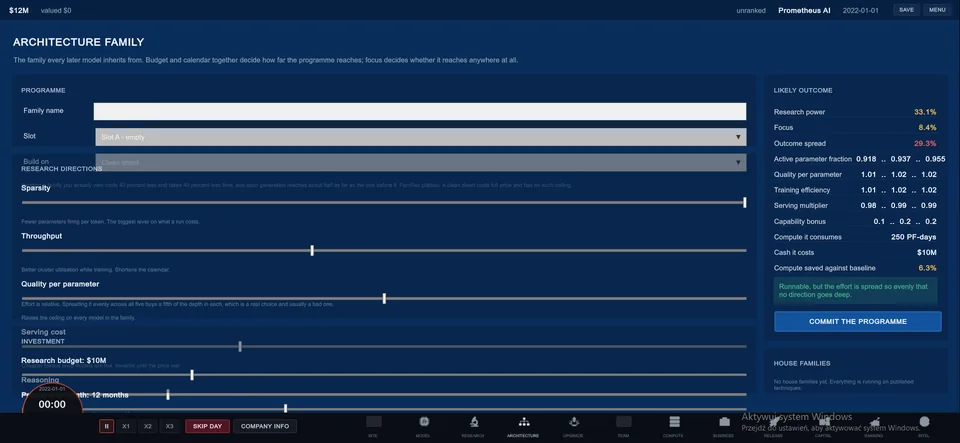
House architecture programmes use the same logic. A company distributes effort across sparsity, throughput, quality per parameter, serving cost and reasoning. A programme chasing every direction spreads itself thin. A short, underfunded programme carries wider outcome variance.

Scaling Laws research tree spanning multiple technology eras
The current research tree. Unlocks have both prerequisites and calendar gates.
Scaling Laws custom architecture programme with five research directions, budget and duration
An in-house architecture programme trades budget, calendar, focus and result variance.
05 / Rivals & intelligence

The leaderboard does not wait politely for your next release.

Rival labs are agents seeded from a historical release timeline, then allowed to wait, rush and drift away from it as the campaign changes.

A patient rival can notice that a better accelerator generation is close to its planned training window and deliberately wait. A frontier-focused rival that falls too far behind can rush, accepting a capability penalty to ship earlier. Between releases, labs continue to improve rather than remaining frozen until the next row in a table.

The player can pay for intelligence, but the game separates real accuracy from stated confidence. The cheapest rumour tier is designed to sound more certain than it actually is. A report can therefore be useful and still be wrong.

Intelligence note / illustrative UIRumour desk
A rival may be holding its next run for incoming silicon.
The desk is allowed to report a plausible signal even when the underlying signal is false. The hidden truth value is never exposed to the player.
80%stated confidence
Important distinction

In the current design, the cheap rumour tier can be right 58% of the time while presenting itself with 80% confidence. That gap is intentional. Paying for information buys a better decision surface, not omniscience.

06 / Market, audience & capital

Capability matters. So do price, brand and being six months late.

Demand is not a direct conversion from model score to revenue. Live products compete on capability, brand, price and age, against both the player and rival labs.

Capability
+
Brand
+
Price
+
Age

The audience changes with time too. Consumer, developer, enterprise, creative and autonomous segments follow different size curves across the campaign. Specialist model types can reach fewer people while selling to an audience that tolerates a higher price. That is the intended trade, not a hidden multiplier.

Funding has its own timing problem. The valuation model combines proximity to the frontier with annual run rate and multiplies the result by investor sentiment. Raising in a hot market can therefore preserve far more founder ownership than raising the same amount during a cold one.

FundingMarket / game formulaequity timing
valuation = (frontier4 × 2B + ARR × 20) × sentiment
This is a game economy formula. It is not presented as a general startup valuation model.
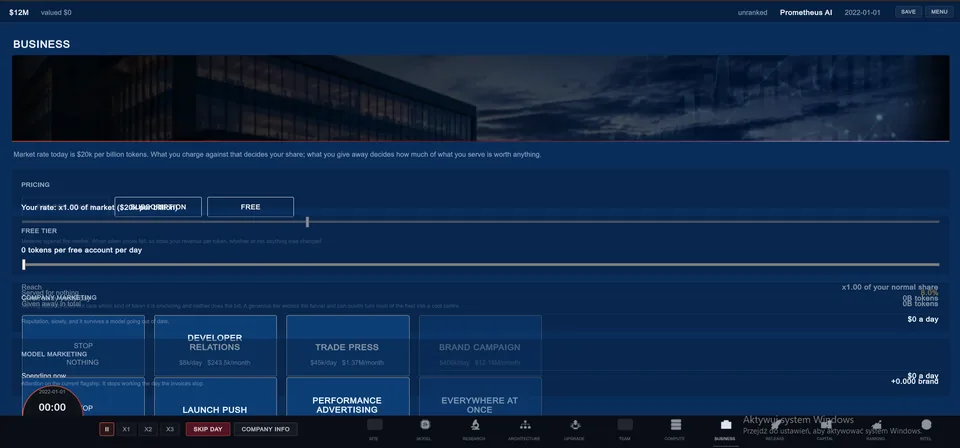
Scaling Laws business screen with pricing, free tier and marketing decisions
The business layer sits on the same demand model as the ranking and company economy.
07 / Data honesty

A projection should look like a projection.

The project keeps estimated future hardware and model releases separate from known reference data, and keeps a training projection separate from a finished model.

Known reference

Vendor and release data

Public specifications and release information are rounded into catalogs. Known entries are treated as reference data, not guesses.

Projection

Future hardware and releases

Entries beyond the known timeline carry a projection flag so the interface can label them rather than blend forecast and history together.

Outcome

Training projection ≠ model capability

A projected run never silently becomes a deployed score. Only a finished run creates capability, and the result lands near the estimate rather than exactly on it.

The same rule applies to this website. Planned systems are described as planned. A screen existing in Unity is not automatically called “shipped,” and an internal projection is not promoted to a historical fact because it looks plausible.

08 / Testing & determinism

A green build can still be wrong. So the tests attack the economy too.

The simulation is isolated from Unity, deterministic and testable without loading a scene. Separate tests then guard playability, cross-catalog consistency and scene wiring.

Playability

Can an ordinary company survive?

A scripted multi-year baseline campaign checks that an ordinary player can stay solvent and competitive without trivially dominating the field.

Consistency

Can the catalogs contradict each other?

Catalog sweeps look for NaN values, impossible ranges, dangling references and unlock chains that can never be reached.

Determinism

Can the same campaign replay?

Simulation randomness comes from a saved deterministic generator. The same seed and the same decisions produce the same numbers.

Persistence

Can an old save move forward?

Save migrations move one version at a time, preserve old shapes and record when a historical field had to be reconstructed.

This structure has already found bugs that looked reasonable on screen. Three are especially useful because they changed the design rather than just fixing a typo:

01
Rental cost jumped when cloud hardware generations changed.Renting was stored as a unit count. It is now contracted in petaflops so a vendor refresh does not triple the bill without a player decision.
02
Serving at full training-active parameters made capability almost irrelevant.Everyone became capacity-bound, so revenue collapsed into a compute equation. Production serving now uses a smaller descendant factor so model quality matters again.
03
A research node unlocked before its own prerequisite.The node looked valid in isolation and was permanently unreachable in the actual tree. A consistency test now checks the whole dependency graph.
09 / Active development line

What is still becoming a game instead of a simulation.

The core economy is further ahead than the physical company layer. The next work turns existing simulation state into things the player can see, configure and walk through.

In development

Hardware purchasing and configuration

A dedicated interface for renting or buying compute, then pairing accelerators with CPUs, memory and fabric instead of buying a magic “server score.”

Planned layer

Staff and larger offices

The starter home becomes the first rung. Hires need a physical place to appear, and later offices should make company growth visible rather than only financial.

Planned layer

Safety incidents

Safety already affects the model and founder systems. Incidents are the missing downside that can turn a weak safety choice into reputation and regulatory damage.

Physical world

Founder movement

Walking to the workstation, garage and later company spaces is presentation over the simulation, not a new source of truth for the rules.

Research & source material

Where the real-world parts come from.

These sources inform the scaling-law choice or hardware reference data. They do not mean the game reproduces a real lab or datacenter one-to-one.

Paper / 2022
Training Compute-Optimal Large Language Models

Hoffmann et al. The Chinchilla paper behind the compute-optimal scaling reference.

Read paper
Paper / 2024
Chinchilla Scaling: A replication attempt

Besiroglu et al. Re-examines the third fitting procedure and derives a fit compatible with the paper's first two approaches.

Read paper
Vendor specs
NVIDIA H100 Tensor Core GPU

Official product specifications used as an example of the memory, bandwidth, power and interconnect dimensions stored by the hardware model.

Open NVIDIA
Vendor / 2024
NVIDIA Blackwell platform announcement

Public generation and system information illustrating why the hardware frontier is treated as a calendar rather than a static catalog.

Open NVIDIA
Project source
Scaling Laws source repository

The implementation, engineering notes and development history remain public while the game changes.

Open GitHub

Game formulas such as depreciation, cloud lag, investor sentiment, rival decision rules and the relative capability index are simulation design choices. Where the project uses estimated future entries, the intended UI rule is to label them as projections.

Back to the game

The mechanism map is useful only if the decisions feel good to play.

The public roadmap will track what has moved from foundation to playable, polish and finally shipped. Until then, the main page shows the current visual build and the repository shows the work underneath it.